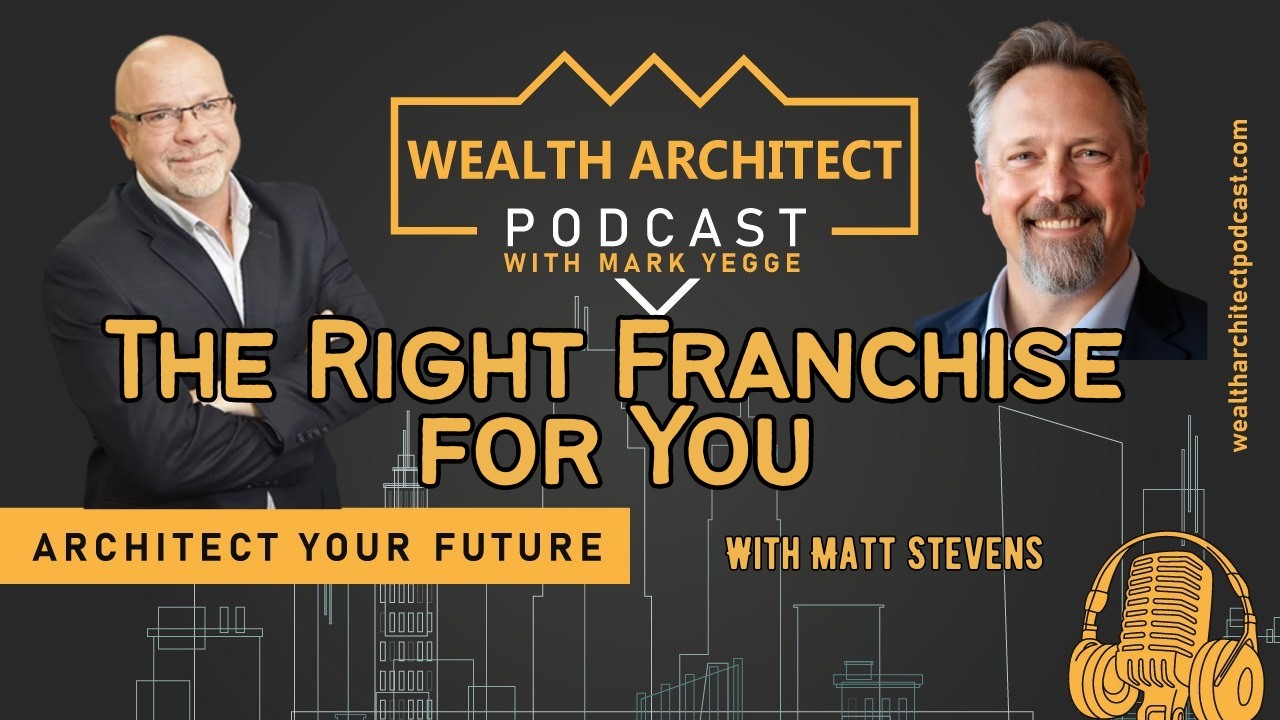
Most people think choosing a franchise starts with a brand they already love. Matt Stevens, known nationally as The Franchise Guy, believes it should start somewhere else entirely. On the Wealth Architect Podcast with host Mark Yegge, Matt breaks down how to choose the right franchise. Start with your own goals and lifestyle first, then work backward to the systems, the numbers, and the questions that actually matter.
Key Takeaways from This Episode
- Matt Stevens has placed nearly 1,000 people as franchisees, across more than 40 states, with investments ranging from $30,000 to mid-eight figures.
- Working with a franchise consultant helps franchisors and candidates find each other on purpose, instead of hoping the right match shows up through open advertising alone.
- The matching process starts with the candidate’s ownership criteria and desired outcomes, not with a list of brand names.
- There are roughly 4,300 franchise opportunities available, spanning far more industries than most candidates realize.
- Candidates typically speak with at least three franchise owners before eliminating a brand, and at least six before saying yes.
- Franchise investment ranges vary enormously. Chick-fil-A’s franchise fee is about $10,000 because the franchisor controls nearly everything, while most equity based systems require high six figures to seven figures.
- The biggest risk in franchising is behavioral. Believing the business will run itself is the mistake Matt sees most often.
- Franchise ownership is not one size fits all. Options range from full time commitments of 60 to 70 hours a week to semi-active ownership models.
What The Franchise Guy Actually Does
Matt Stevens’ franchise story goes back to 1987, when he joined a predecessor to what is now a painting franchise system worth well over a billion dollars, with roughly 500 operations today. At the time, he was one of about 67 to 70 franchisees spread across Canada and New England. He was 20 years old in his first business, and by the time he was 23 he had logged 15,000 labor hours in the industry, learning how to bill, how to be reliable to customers and employees, and how to run a business the hard way, in real time.
He stayed on that path for three years as a franchisor employee, but the travel took its toll. He was on the road for the first three years of his oldest daughter’s life, and he decided something had to change. A friend introduced him to franchise consulting, and he’s spent the 25 years since building The Franchise Guy, bringing nearly 40 years in franchising altogether to every candidate he works with. He’s helped more than 3,000 people explore franchise ownership along the way, describing himself simply as Match.com for franchising.
The Franchise Guy exists to help great franchisors find the right candidates, and to help great candidates find the right franchisors. Franchisors who advertise on their own, through online ads, magazines, or home shows, are casting a wide net and hoping the right person notices. Matt’s job is to make that connection on purpose instead of by chance, so both sides know they’re a genuine fit before any money changes hands.
Why Ownership Criteria Come Before Brand Names
Matt does not start a candidate conversation by pulling up a list of franchise brands. He starts by wiping the slate clean and talking through ownership criteria and desired outcomes: what does the candidate want their life to look like down the road, and why does that picture matter to them. Only after establishing the “what” and the “why” does he move to the “how.”
From there, he measures candidates against roughly two dozen to 30 ownership criteria: access to capital, tolerance for labor hours, how long they can wait before generating income, who they want to manage, what days they want their location open, who they want their customer to be, and why a particular industry appeals to them in the first place. Evaluating a franchise opportunity this way, criteria first and brand second, is what separates a deliberate candidate from someone chasing a name they already recognize. With roughly 4,300 franchise opportunities on the market, most of them never cross a typical candidate’s radar until someone narrows the field for them.
How Franchise Due Diligence Actually Works
Once Matt has a shortlist of “standing opportunities” for a candidate, the real research begins. Candidates learn everything they can about the franchisor and its franchisees, get access to territory information, and get Q and A time with individual owners or in group settings. Matt tells candidates to expect three weeks to three months to reach a decision, whether that decision is a yes on one opportunity or a no on all of them. Eliminating every option on the list is a perfectly acceptable outcome of the process.
The most important part of that research is talking to current and former franchise owners directly, and asking nosy questions. What are they doing differently, and why. Have they deviated from the franchisor’s playbook, and did that help or hurt. What would they change if they started over. Matt’s rule of thumb is that candidates should speak with at least three owners before eliminating a brand, and at least six before saying yes, since after six conversations the answers tend to repeat. He’s had candidates speak with 29 or more owners before committing. The whole process of exploring a franchise ultimately comes down to one question every candidate has to answer honestly: am I ready, willing, and able to do what the successful people in this system are doing to get the results I want to replicate.
What a Franchise Investment Really Costs
Franchise fees and investment levels vary far more than most first time candidates expect. Chick-fil-A is the extreme example Matt points to. The franchise fee is about $10,000, among the lowest in franchising, because Chick-fil-A controls nearly every major decision, including site selection, location, and advertising. The franchisee simply operates the store. That structure is also one of the most competitive in franchising, with roughly 10,000 applications a year for only 70 to 75 open locations. 7-Eleven follows a similar model, with the franchisor owning the property and making most of the decisions.
Most of Matt’s candidates want equity instead, and the majority of franchise systems are built to offer it. For those systems, the investment is typically high six figures at minimum, often reaching seven figures, and it can take 9 to 15 months to actually open the doors, sometimes 18 months or longer. Understanding what it really costs to become a franchisee means looking past the headline fee and into the full investment range, the timeline, and what level of control comes with it.
The Real Benefits of Joining a Proven System
Matt has placed nearly 1,000 people as franchisees across more than 40 states, with investments ranging from $30,000 up into the mid-eight figures, though most land in the high five to low seven figure range. None of them needed a franchise to build the business they ended up building. They chose one for specific reasons. First, community: franchise owners are surrounded by like minded people working toward similar goals. Second, inherited experience: candidates absorb the lessons other franchisees have already learned the hard way, through training and ongoing operations support, without having to relearn them through their own costly mistakes.
Third, the system itself: owners follow a documented template instead of building operations from scratch and living through every mistake that entails. Fourth, economies of scale. Matt’s own experience in the painting industry is the clearest example. A piece of direct marketing sent to a likely customer cost franchisees roughly $0.44 through the franchisor’s bulk purchasing power, compared to close to $2 if he had produced it on his own. For candidates in their 40s and 50s in particular, a franchise consulting relationship compresses a multi-year learning curve into months rather than years.
What Can Go Wrong, and How to Manage the Risk
Franchising reduces risk, but it does not eliminate it. Some risk is simply outside anyone’s control, like a city tearing up the street in front of a location to replace a sewer line and cutting off front door access for three to six months. Most risk, though, is behavior driven. The biggest mistake Matt sees is a new owner believing the business will run itself. It never does. Someone has to pay attention to the daily outcomes, whether that’s the owner personally or someone the owner hires and incentivizes, sometimes with phantom equity or other rewards, to run it on their behalf.
That is exactly where semi-active franchise ownership comes in for candidates who want the upside of franchise ownership without being on site every day. It’s one more reason ownership criteria, including how hands on a candidate actually wants to be, need to be established before a brand is ever chosen.
Finding the Franchise That Fits Your Life
Some of Matt’s favorite placements illustrate just how wide the range of franchise ownership really is. One candidate lives off the grid, generating his own electricity from solar and heating his home with wood, and has run a very successful, mid to high range net income franchise for nine years, closing in on his ten year anniversary. Another candidate bought franchises in North Dakota, Minnesota, and Florida with the explicit goal of building five or more locations and then stepping back, using the eventual sale as his retirement plan.
Those examples reflect the full range of commitment levels available in franchising: some systems suit owners who want to invest 60 to 70 hours a week, others suit a more typical 30 to 40 hour workweek, and others are built for semi-active ownership, run through a manager or team while the owner stays involved from a distance. The common thread, in Matt’s words, is what candidates are actually building toward.
“We find the ones that are a fit for those who really like that opportunity and want to build wealth and what I call the freedoms of time, money, people, and purpose.”
Matt Stevens, Wealth Architect PodcastIf you want help finding that fit for your own life, rather than guessing based on a brand you already recognize, the first step is simple: a conversation about your own goals. Reach out to Matt directly to talk through which categories, investment levels, and time commitments actually fit your life.

Matt Stevens Independent Franchise Consultant, The Franchise Guy
Nearly 40 Years in Franchising | 4 Businesses Owned | Nearly 1,000 Franchisees Placed | heisthefranchiseguy.com
Matt Stevens has spent nearly 40 years in franchising. He’s helped more than 3,000 people explore franchise ownership and placed nearly 1,000 of them as franchisees across more than 40 states. He has owned four businesses and served as Vice President and Partner in a $2 billion international franchise holding company. He works as an independent franchise consultant based in Dublin, Ohio, and his consulting is free to the candidate. Learn more about Matt
Published: | Last Updated: | LinkedIn
Frequently Asked Questions
A franchise consultant matches candidates to franchise systems based on their goals, lifestyle, and investment level, rather than steering them toward a single preferred brand. Matt Stevens describes his role simply as Match.com for franchising: he works with franchisors to find the right candidates, and works with candidates to find the right franchisors. Because he learns both sides in depth, he can flag mismatches before any money changes hands.
It starts with the candidate, not with a list of franchise brands. Matt begins by setting aside any specific franchises the candidate already has in mind and instead talks through their desired outcomes: what they want their life to look like, and why. From there he measures the candidate against roughly two dozen to 30 ownership criteria, including access to capital, tolerance for labor hours, income timeline expectations, who they want to manage, what days they want their business open, and why a given industry appeals to them. Only after that picture is clear does he bring specific franchise opportunities into the conversation.
There are roughly 4,300 franchise opportunities available, and only a small number are typically available for purchase in any one candidate’s territory at a given time. Most people default to a franchise they already know from advertising or a friend’s experience, without realizing how many other options exist across dozens of industries. Part of a consultant’s job is narrowing that full field down to a short list of opportunities that actually match the candidate’s own criteria, rather than leaving the candidate to search through thousands of options alone.
When a franchisor advertises alone, they’re relying on volume and hoping the right person notices. Working with a consultant means the candidates who reach out have already been matched against real ownership criteria, not just interest in an ad. That’s better for the franchisor and for the candidate, because both sides know going in that the fit makes sense. It also cuts both ways: a consultant who brings the wrong candidate to a franchisor, or the wrong franchisor to a candidate, hears about it directly, which keeps the incentive pointed toward genuine fit rather than volume.
Ready to Find the Right Franchise for Your Life?
Matt Stevens has helped more than 3,000 people explore franchising and placed nearly 1,000 of them as franchisees across more than 40 states. If you’re ready to find out whether franchising could work for you, start with the quick fit quiz on his website. It takes just a few minutes and points you to a clear next step. If you’d rather talk it through first, Matt offers a free 15 minute consultation through the contact form, at no cost to you regardless of what you end up investing.
Talk to Matt. It’s Free