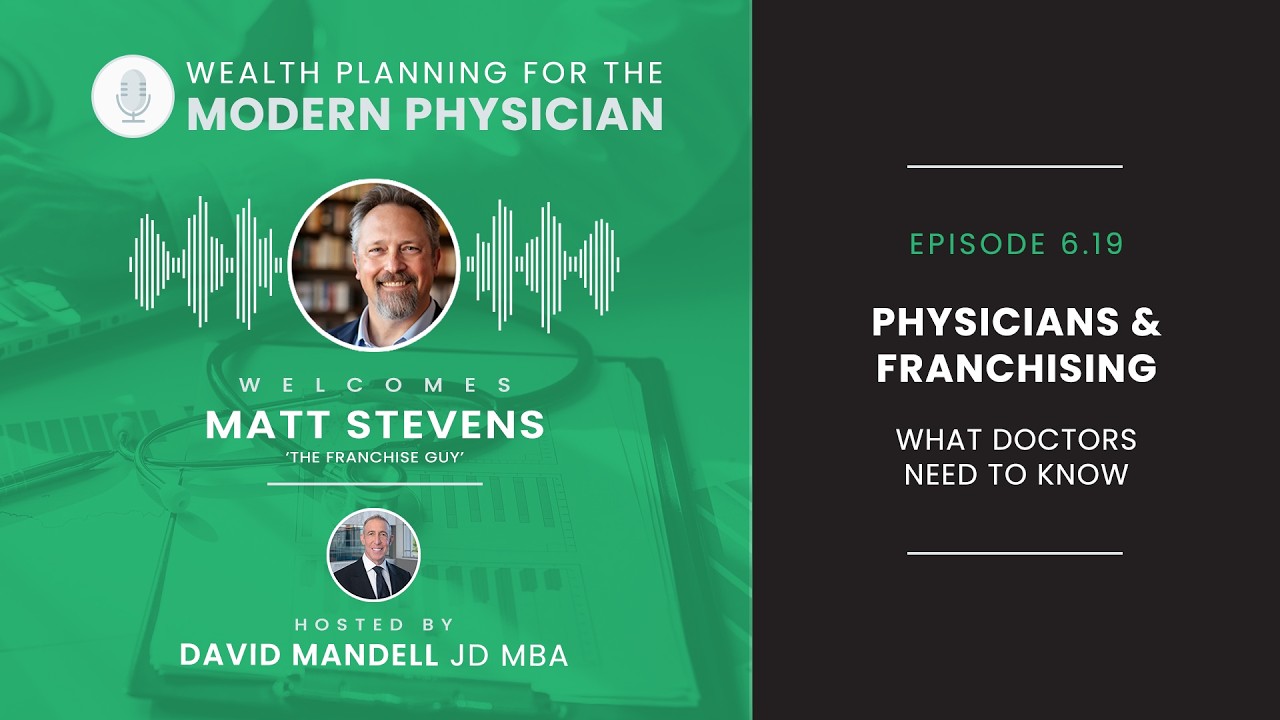
Most physicians already know what it costs to learn a skill the hard way. You did it once, in medical school and residency, and you are in no hurry to do it again. On the Wealth Planning for the Modern Physician podcast, host David Mandell, a partner at OJM Group, sits down with Matt Stevens to talk about why doctors, dentists, and other busy medical professionals are looking at franchise ownership as a way to build a second stream of income, without stepping away from the practice they already built.
Key Takeaways from This Episode
- Franchising can buy down the learning curve. Instead of spending three to seven years making expensive mistakes on your own, a franchise fee gets you a tested playbook, real training, and a support system from day one.
- There are roughly 4,300 franchise brands across about 80 industries, evaluated against about 30 different ownership criteria, so physicians are not limited to food and retail.
- Physicians rarely need to run day-to-day operations themselves. A managing operator, a family member, or a semi-active ownership structure can carry the business while the physician stays focused on their practice.
- Item 20 of the Franchise Disclosure Document shows three years of franchisee turnover data and is one of the clearest tools for spotting a healthy system before you invest.
- Some franchise structures allow tax advantages, including property-related deductions, that can meaningfully offset a physician’s income in the early years of ownership.
- Franchisors earn most of their money on ongoing royalties, not the upfront franchise fee, which means the strongest systems have a real financial incentive in your success.
- Matt Stevens works with candidates at no cost. He is compensated by the franchisor out of the franchise fee, so a physician pays the same fee whether they use a consultant or not.
- Exit planning starts on day one, not year ten. Owners who plan their eventual sale from the beginning tend to build businesses that are easier to hand off or sell later.
Why Franchising Appeals to Physicians With Limited Time
Matt Stevens has worked with a lot of doctors and physicians across the country, and the reasoning he hears keeps coming back to the same idea: we all live finite lives, and physicians understand that better than most. The question he poses to candidates is simple. Do you want to spend the first three to seven years of a new business making expensive, untimely mistakes you cannot predict, or would you rather spend a franchise fee and buy down that learning curve significantly? A franchise can put an owner in year one, two, or three of a business where they might otherwise have landed in year five, seven, or nine on their own.
For physicians specifically, Matt describes the ownership criteria that matter most as limited time involvement and a role that does not compete for urgency with their medical practice. That is a very different filter than what a typical franchise candidate uses, and it is why semi-active franchise ownership comes up so often in these conversations. A physician does not need to be the one opening the store or running the route. They need a model built to run without their daily presence.
What a Franchise Actually Is, and Why There Are Thousands to Choose From
A franchise, in Matt’s definition, is an authorization to carry out specific commercial activities under a brand’s system and support structure. Brand recognition matters less than most people assume. What matters more is the team behind the system and how well it has been proven. There are roughly 4,300 franchise brands operating today across about 80 different industries, and Matt evaluates candidates against roughly 30 different ownership criteria to narrow that field down to the two, three, or four opportunities that actually fit.
Not every brand survives. Matt points out that from 2000 to 2009, roughly 900 new brands entered franchising for the first time, and most of them do not exist anymore. They never made it to a second or third franchise owner. That history is exactly why understanding the whole process of exploring a franchise matters before signing anything, and why serious validation calls with existing owners carry so much weight in the sections below.
Passive and Semi-Active Ownership: How Physicians Actually Run a Franchise
David Mandell raised the obvious concern directly: physicians have very limited time. If a doctor wants to invest capital and interest without personally running a business, how does that work? Matt’s answer is that a franchise still needs someone to drive the train. There is no free lunch. But that driver does not have to be the physician. Matt has placed franchises for busy professionals who never intended to work in the business day-to-day, including a case in New Jersey where a 52-year-old sibling took on the operating role for his physician brother.
Some franchise systems will not even open a location until a managing operator is identified and in place. That structure gives a physician a way to participate in franchise ownership without stepping away from their practice, whether the operator is a hired manager, a spouse, or an adult child looking for a better opportunity than the one they currently have.
Tax and Wealth Planning Considerations for Physician Franchise Owners
David, speaking from his own background structuring entities and retirement plans for physicians, asked whether the franchise playbook typically covers tax and legal structure, or whether that work stays with the physician’s own team. Matt was direct about it. The franchisor generally will not have the resources to advise every individual on their specific tax situation. That work still belongs to the physician’s own financial and legal team.
That said, some franchise models are structured in ways that create real tax benefits. Matt described a franchisee with four locations, two near the Canadian border and two in Florida, whose taxes in the first three and a half years of operation, through property-related deductions tied to the business model, essentially offset the profit he had made. Matt’s advice for physicians weighing what it actually costs to build a franchise is to loop in their accountant and their financial planner before signing, not after, since decisions about LLC versus corporation, or S-corp versus C-corp, are easier to get right on the front end.
“We all live finite lives. Physicians certainly understand that. Do you want to invest the first three to seven years of any business making expensive, untimely mistakes you can’t predict? Or would you rather spend a franchise fee and literally buy down that learning curve significantly? That’s what franchising does.”
Matt Stevens, on the Wealth Planning for the Modern Physician podcastHow to Vet a Franchise Before You Invest: The FDD and Item 20
Every franchisor is required to provide a Franchise Disclosure Document, or FDD, containing 23 standardized items. Matt points straight to Item 20, which shows the three-year history of the franchisee base, including how many owners succeeded and how many shut down. He tells every candidate the same thing: take notes, do not turn assumptions into conclusions, ask questions, and go from there.
Beyond the document itself, Matt has candidates speak directly with current and former franchisees, in group settings, on recorded calls, or one on one. After several of those conversations, a candidate can honestly ask whether they are willing, ready, and able to replicate what the top producers in that system are doing. He also flags that franchisors cannot compel any franchisee to talk, so it is worth seeking out owners at the specific stage you are curious about. Someone who has passed the 18 to 20 month mark is usually on the way to success. If it is not working by then, it usually is not going to. Reading through how to evaluate a franchise opportunity in more depth is a useful next step before those conversations.
Red Flags and Success Factors Physicians Should Watch For
Royalty structure is one of the clearest signals of alignment. Franchisors typically earn a percentage of a franchisee’s top-line revenue, charged weekly or monthly, while the one-time franchise fee rarely even covers the franchisor’s cost of onboarding a new owner. A system built to profit mainly on royalties needs its franchisees to succeed, which is a very different incentive than one built to profit on the fee itself.
On the owner’s side, Matt’s word for what separates success from struggle is engagement. Franchisees who engage with successful peers, attend regional meetings, take part in question and answer sessions, and use the franchisor’s flight groups or online forums tend to do well. As Matt puts it, if you want to go out and be on your own island, you can do that, but you are missing out on the learning curve you already paid for.
Planning Your Exit From Day One
Exit planning came up as a theme physicians should take seriously before they ever sign. Matt uses 18 months as a rough marker for owners who are simply not going to stick with something that is not working out. On the other end, he described Lawn Doctor, a 50 to 60 year old legacy brand where the oldest franchisees are now on their fifth franchise agreement, having handed the business down through their own families over decades.
For a resale example, Matt described a business in Portland, Maine that a fellow consultant placed. The original owner built it for 14 years, trained a team to run the day-to-day work, and went through a full resale process, from valuation to marketing to close. Matt offers every candidate, whether he placed them or not, a free 30-minute call to walk through what a resale actually looks like and how a franchisor can help market the sale when the time comes.
Working With a Franchise Consultant at No Cost to You
Matt has helped more than 3,000 people explore franchising and placed nearly 1,000 of them as franchisees across more than 40 states. His process starts with a fact-finding conversation, measuring a candidate against dozens of ownership criteria, from the most important down to the least. Once that picture is clear, he makes the physician the center point of the search and reverse-engineers the process around them, rather than starting from a list of available brands. Learning more about what a franchise consultant actually does makes it clear why this approach matters for a candidate with limited time to research thousands of brands alone.
The financial arrangement is straightforward. If a candidate becomes a franchise owner, the franchisor pays Matt out of the published, public franchise fee the candidate was always going to pay. The fee does not change based on whether a consultant is involved. Matt’s franchise consulting services are free and without obligation, which is why he tells every candidate the same thing: he wants them happy enough with the outcome to recommend him to everyone they know. Reach out to start the conversation and find out whether a franchise fits your goals, your schedule, and your practice.
Frequently Asked Questions
A franchise is an authorization to carry out specific commercial activities under a brand’s proven system, training, and support structure, in exchange for a franchise fee and ongoing royalties. For physicians, the appeal is not the brand name. It is the ability to buy down years of trial-and-error learning that a new business normally requires, while gaining access to a network of other owners in their own protected territories who are not competing against them and are often willing to share what worked and what did not.
There are roughly 4,300 franchise brands operating today, spread across about 80 different industries, from food and fitness to home services, senior care, and business coaching. Franchise consultants typically evaluate candidates against around 30 different ownership criteria to narrow that full field down to the handful of systems that actually fit a candidate’s schedule, budget, and interests, rather than starting from brand recognition alone.
Physicians and other busy professionals typically cannot afford to have their focus pulled away by a demanding new business. Franchising can offer a defined ownership role, limited time involvement, and a system that does not compete for urgency with an existing medical practice. It also gives physicians access to other owners, and in some cases other medical professionals inside the same franchise system, who understand their situation and can speak their language.
That is the central premise of franchising, according to Matt Stevens. Starting a business independently often means spending three to seven years making expensive, unpredictable mistakes. A franchise fee buys access to a playbook that has already been tested, along with training designed to catch most of those mistakes before they happen. The goal is to put an owner in year one, two, or three of a business where they might otherwise have landed in year five, seven, or nine on their own.
Ready to Find the Right Franchise for Your Life?
Matt Stevens has helped more than 3,000 people explore franchising and placed nearly 1,000 of them as franchisees, at no cost to the candidate. Take the quiz on heisthefranchiseguy.com to start the conversation, or reach out for a free 15-minute consultation to find out which categories fit your goals, your investment range, and your schedule.
Talk to Matt. It’s FreeAbout Matt Stevens

Matt Stevens Independent Franchise Consultant, The Franchise Guy
Nearly 40 Years in Franchising | 4 Businesses Owned | Nearly 1,000 Franchisees Placed | heisthefranchiseguy.com
Matt Stevens has spent nearly 40 years in franchising. He’s helped more than 3,000 people explore franchise ownership and placed nearly 1,000 of them as franchisees across more than 40 states. He has owned four businesses and served as Vice President and Partner in a $2 billion international franchise holding company. He works as an independent franchise consultant based in Dublin, Ohio, and his consulting is free to the candidate. Learn more about Matt
Published: | Last Updated: | LinkedIn